People search for "bendable fiberglass rods" with two opposite goals in mind. One buyer wants a springy rod that arcs into a dome tent, plant hoop, kite spar, or conduit fish tape and snaps back straight when packed away. Another buyer wants a "flexible rod that holds shape" like a camera gooseneck or craft armature.
Fiberglass only does the first job. Being upfront about that saves wasted samples and broken rods.
Why fiberglass springs back instead of holding a shape
Annealed aluminum, copper, and mild steel yield plastically: once bending stress passes the yield point, crystal planes slip permanently and the wire holds its new curve. Pultruded fiberglass has no ductile yield plateau. Glass fibers stretch elastically straight up to brittle fracture, and the thermoset polyester, vinyl ester, or epoxy matrix is permanently cross-linked during cure.
That means three rules apply to every cured fiberglass rod:
- Below its strain limit, it acts as a linear spring. Bend it into a hoop, tie down both ends, and it stays arched under constant stored energy; release one end and it whips straight back.
- Beyond its strain limit, it splinters. Outer tensile fibers snap or inner compressive fibers micro-buckle, turning the curve into a frayed hinge rather than a smooth permanent bend.
- Heating will not form it. Reheating a cured thermoset rod scorches and weakens the resin instead of letting you reshape it. Curved FRP parts (such as bent GFRP rebar stirrups) have to be bent on tooling before cure.
If your application genuinely needs a flexible rod that holds shape, skip fiberglass and specify annealed solid metal wire, a braided or corrugated metal-core gooseneck, or a heat-formed thermoplastic rod (nylon, HDPE, or acrylic).
The bending mechanics: why diameter controls everything
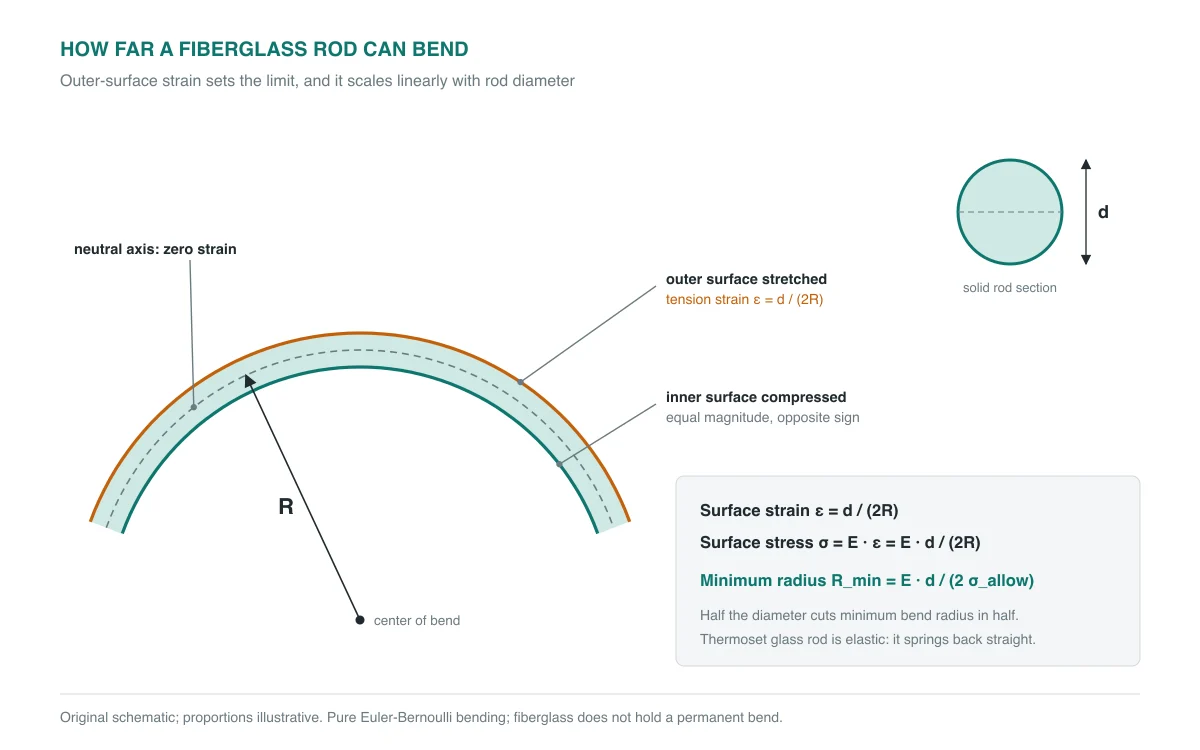
Under pure Euler-Bernoulli beam bending, a straight solid round rod of diameter d bent to a centerline bend radius R experiences zero strain along its central neutral axis, tension along its outer face, and equal compression along its inner face. Maximum surface strain depends solely on the ratio of diameter to radius:
ε = d / (2 · R)
Within the linear elastic region of fiberglass, surface stress is σ = E · ε = E · d / (2 · R). Solving for the minimum allowable bend radius R_min at an allowable bending stress σ_allow gives:
R_min = (E · d) / (2 · σ_allow)
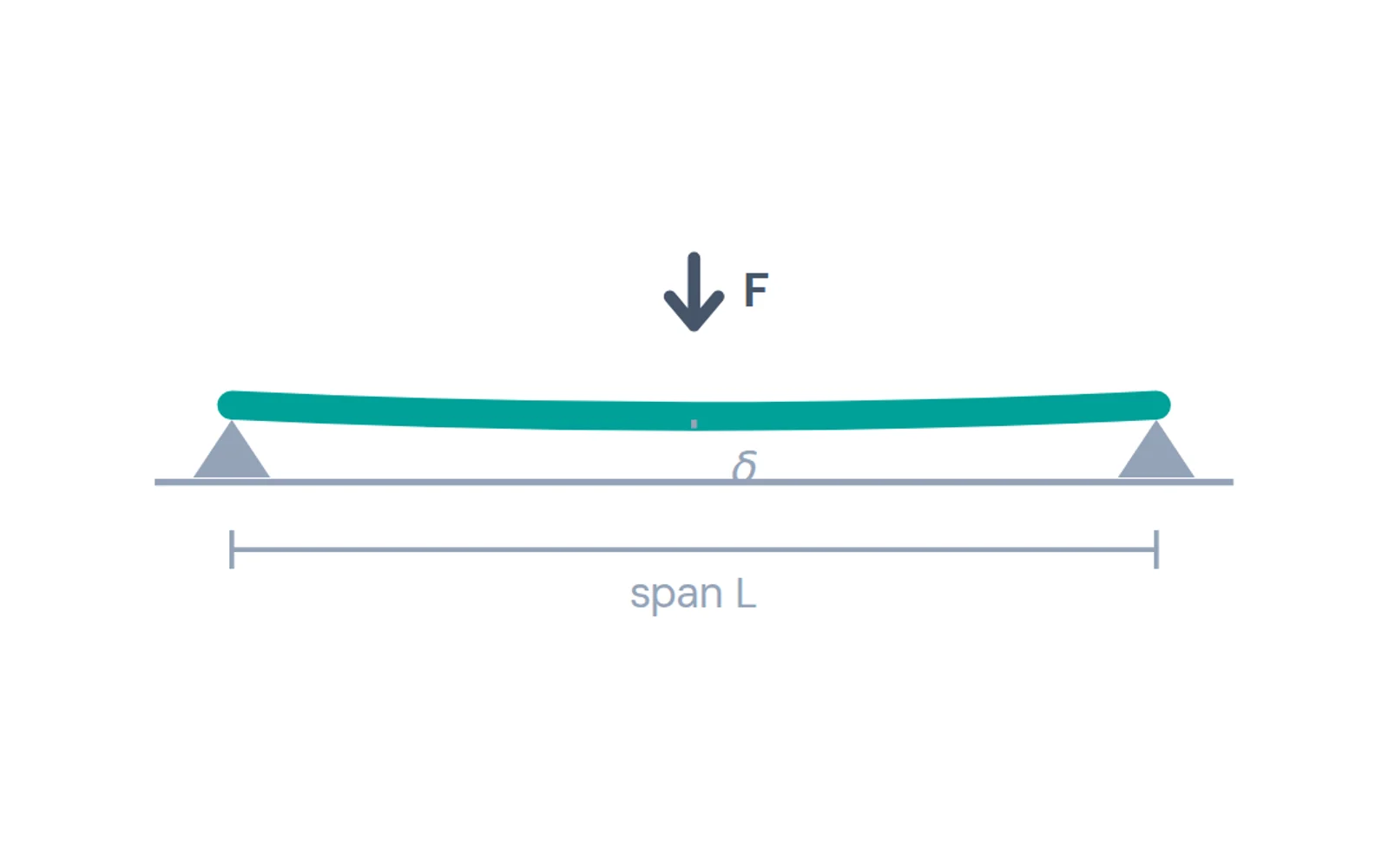
Notice what is missing from that equation: rod length. A 4-meter rod feels far easier to bend by hand than a 1-meter rod because bending stiffness over a span drops with length cubed, yet the tightest curve the material survives without cracking is identical for both. Cutting the rod diameter in half, on the other hand, cuts the minimum bend radius cleanly in half.
Because E-glass is notch-sensitive, surface scratches, deep nick marks from metal pliers, or abrasive gravel wear concentrate stress right on the outermost fiber where bending strain peaks. That is why underground duct rodders are typically extruded with a smooth polypropylene or HDPE protective jacket over the pultruded glass core.
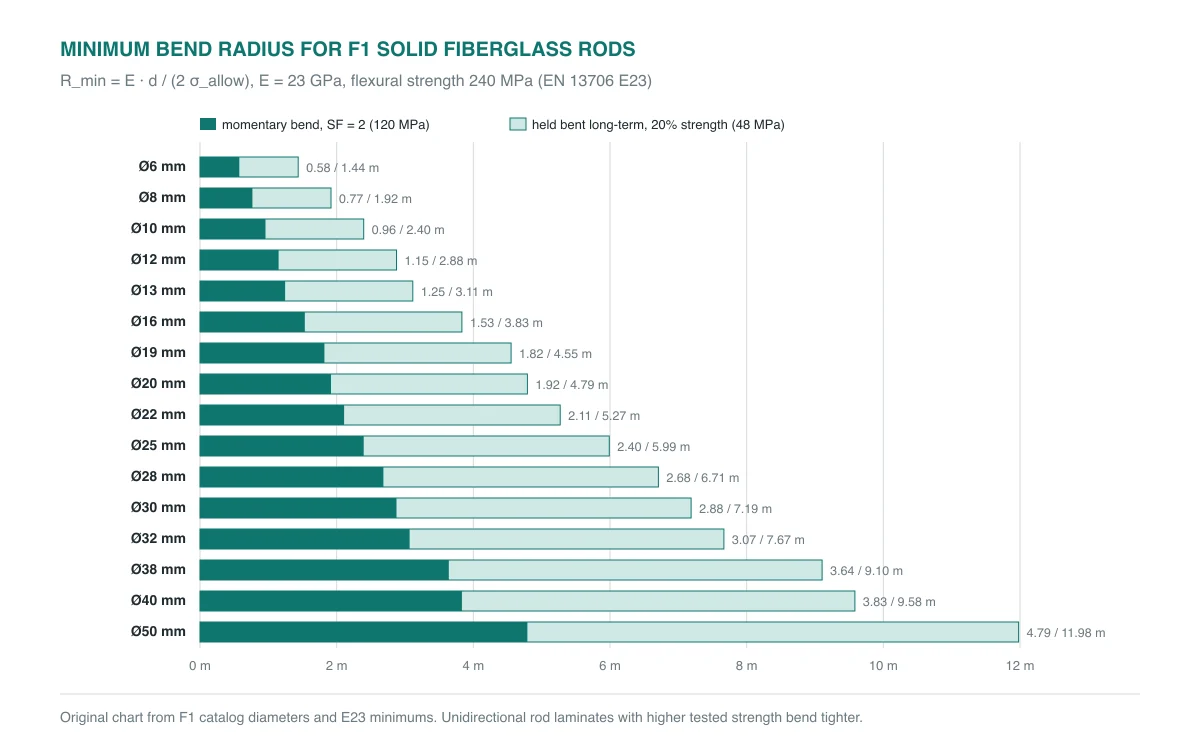
Original table: minimum bend radius for all 16 F1 solid fiberglass rods
The table below applies R_min = (E · d) / (2 · σ_allow) to every solid round rod diameter in F1 Composite's published fiberglass round rod catalog, evaluated using F1's EN 13706 E23 structural reference (E = 23,000 MPa, minimum longitudinal flexural strength σ_f = 240 MPa).
Two working limits are shown alongside the bare E23 floor:
- Momentary flex (SF = 2, σ_allow = 120 MPa): brief bending during installation, snow-plow deflection, or handling.
- Sustained held bend (20% of E23 strength, σ_allow = 48 MPa): conservative stress-rupture limit when a rod is tied permanently into a hoop or arched frame outdoors for months or years.
| Catalog rod | Nominal diameter d (mm) | Catalog weight (kg/m) | R at E23 floor (240 MPa) | Momentary bend R_min (SF = 2, 120 MPa) | Held-bent R_min (20% = 48 MPa) |
|---|---|---|---|---|---|
| Rod Ø6 | 6 | 0.05 | 0.29 m | 0.58 m | 1.44 m |
| Rod Ø8 | 8 | 0.09 | 0.38 m | 0.77 m | 1.92 m |
| Rod Ø10 | 10 | 0.14 | 0.48 m | 0.96 m | 2.40 m |
| Rod Ø12 | 12 | 0.21 | 0.58 m | 1.15 m | 2.88 m |
| Rod Ø13 | 13 | 0.24 | 0.62 m | 1.25 m | 3.11 m |
| Rod Ø16 | 16 | 0.37 | 0.77 m | 1.53 m | 3.83 m |
| Rod Ø19 | 19 | 0.52 | 0.91 m | 1.82 m | 4.55 m |
| Rod Ø20 | 20 | 0.57 | 0.96 m | 1.92 m | 4.79 m |
| Rod Ø22 | 22 | 0.69 | 1.05 m | 2.11 m | 5.27 m |
| Rod Ø25 | 25 | 0.89 | 1.20 m | 2.40 m | 5.99 m |
| Rod Ø28 | 28 | 1.12 | 1.34 m | 2.68 m | 6.71 m |
| Rod Ø30 | 30 | 1.29 | 1.44 m | 2.88 m | 7.19 m |
| Rod Ø32 | 32 | 1.47 | 1.53 m | 3.07 m | 7.67 m |
| Rod Ø38 | 38 | 2.06 | 1.82 m | 3.64 m | 9.10 m |
| Rod Ø40 | 40 | 2.29 | 1.92 m | 3.83 m | 9.58 m |
| Rod Ø50 | 50 | 3.57 | 2.40 m | 4.79 m | 11.98 m |
Important laminate note: EN 13706 E23 (240 MPa) is a conservative structural profile minimum designed for mixed roving-and-mat shapes. All-unidirectional small-diameter pultruded glass rods tested under ASTM D4476 often achieve higher flexural strengths (typically 600 to 900+ MPa with E around 35 to 45 GPa, giving failure strains near 1.8 to 2.2%), which allows tighter bend radii around 45 to 60 × d momentarily. Never assume that tighter radius without a batch ASTM D4476 flexural test on the exact rod formulation being supplied.
Common applications for flexible fiberglass rods
| Application | Typical rod diameter | Why fiberglass is selected | Practical specification note |
|---|---|---|---|
| Greenhouse & raised-bed hoops | 6–10 mm | Lightweight, rust-proof, holds smooth parabolic arch when staked at both ends | Keep radius well above long-term stress-rupture limit; UV veil reduces fiber bloom |
| Dome tent poles (solid or thin tube) | 6–11 mm | Repeatable elastic spring-back without permanent kinking | Metal ferrules at joints must be chamfered internally so edges do not score the glass |
| Underground conduit duct rodders | 4.5–11 mm | High push stiffness plus tight coilability on payout reels | Extruded HDPE/PP jacket protects rod from scratches and splinters |
| Kite spars, whip flags & marker wands | 3–8 mm | Survives gust deflection and bounces back; non-conductive | Confirm resin toughness (vinyl ester or epoxy for extreme flex cycles) |
| Driveway snow markers & nursery tree stakes | 6–16 mm | Flexes under wind or snow-plow glance instead of kinking like steel | See fiberglass driveway markers and fiberglass tree stakes |
Specifying flexible rods for a factory run
F1 Composite pultrudes solid fiberglass round rods from Ø6 mm to Ø50 mm (minimum order 1,000 m per diameter, 4–8 weeks on existing dies). If bending flexibility is central to your part, do not simply order "standard Ø8 mm rod": state your target bend radius, whether the bend is momentary or permanently held, ambient temperature, outdoor UV life, and whether an ASTM D4476 flexural proof test or protective veil/coating is required.
Bendable fiberglass rod questions
Does a flexible fiberglass rod hold its shape after bending?
No. Pultruded fiberglass uses a cross-linked thermoset resin around elastic glass fibers, so it has no ductile yield plateau like steel or copper wire. Release a bent fiberglass rod and it springs straight back; push it past its strain limit and it splinters. If you need a flexible rod that stays bent, choose annealed aluminum or steel wire, a plastic-jacketed metal core (gooseneck), or a thermoplastic rod formed with heat.
Can I heat a fiberglass rod to bend it permanently?
No. Heating a cured thermoset polyester, vinyl ester, or epoxy rod above its glass transition temperature softens and degrades the resin rather than making it safely formable, destroying mechanical strength. Permanent bends in FRP, such as curved concrete rebar stirrups, must be shaped in the factory before the resin cures.
What is the rule of thumb for fiberglass rod minimum bend radius?
At a conservative 1.0% outer surface strain, pure geometry (ε = d / 2R) gives a radius of 50 times the rod diameter (50 × d). That puts an E23 rod right near its 240 MPa minimum flexural strength, so practical working radii are larger: roughly 96 × d for momentary flexing at safety factor 2, and roughly 240 × d for rods held permanently arched in hoops or tent frames under the E23 floor.
Why do duct rodders and tent poles bend tighter than the E23 table?
Dedicated flexible rod products (such as 4.5 to 11 mm duct rodders and tent poles) use 100% unidirectional high-tensile glass roving in a tough epoxy or vinyl ester matrix, giving longitudinal flexural strengths well above the 240 MPa general-purpose EN 13706 E23 structural minimum. Higher verified flexural strength raises σ_allow and shrinks R_min proportionally.
Does cutting a fiberglass rod longer let it bend to a tighter radius?
No. A longer rod bends through a larger total angle (for instance, forming a full 180-degree hoop instead of a gentle bow), so it feels much more flexible in your hands, but the local surface strain depends only on diameter d and bend radius R. Length does not change the minimum bend radius.