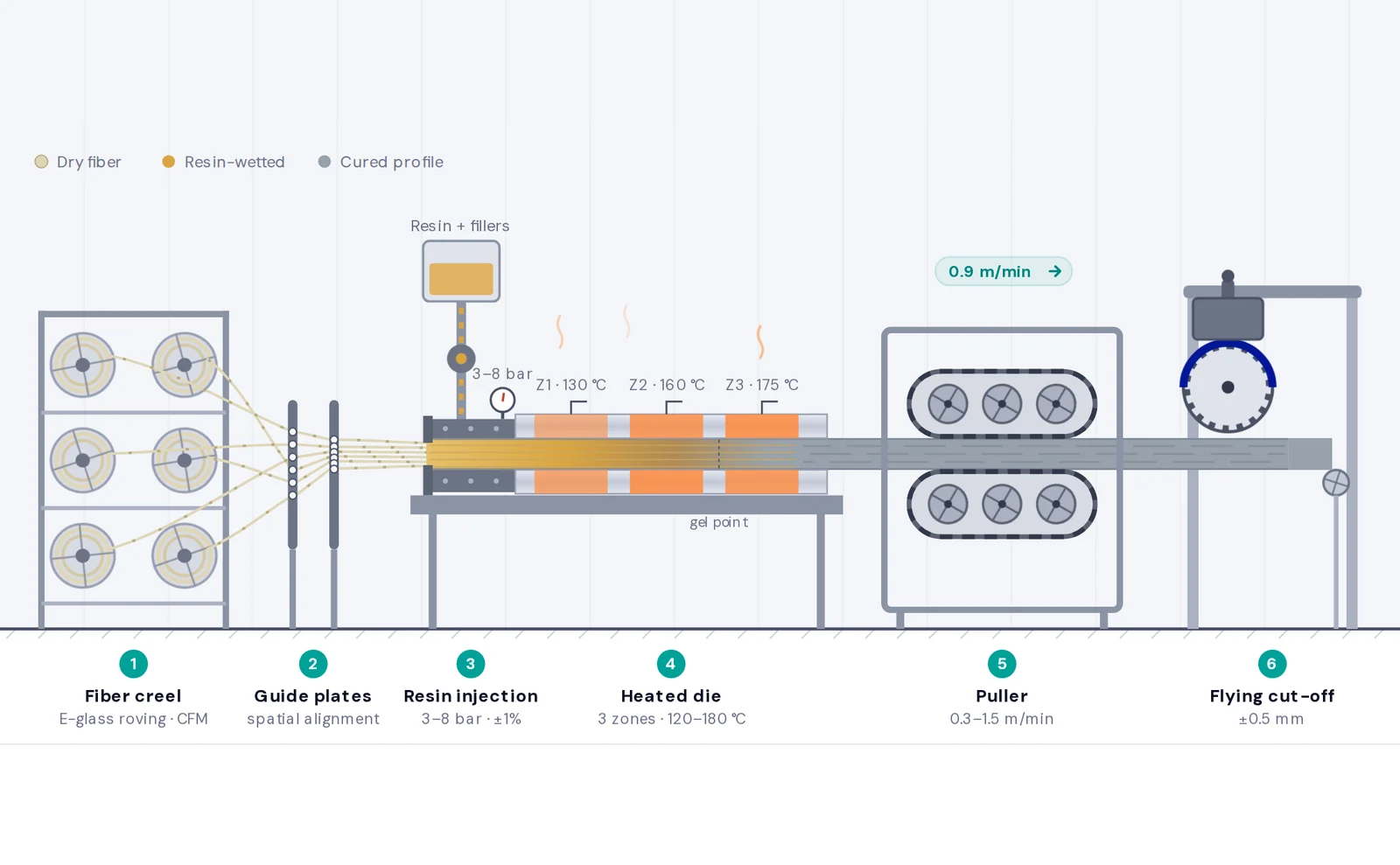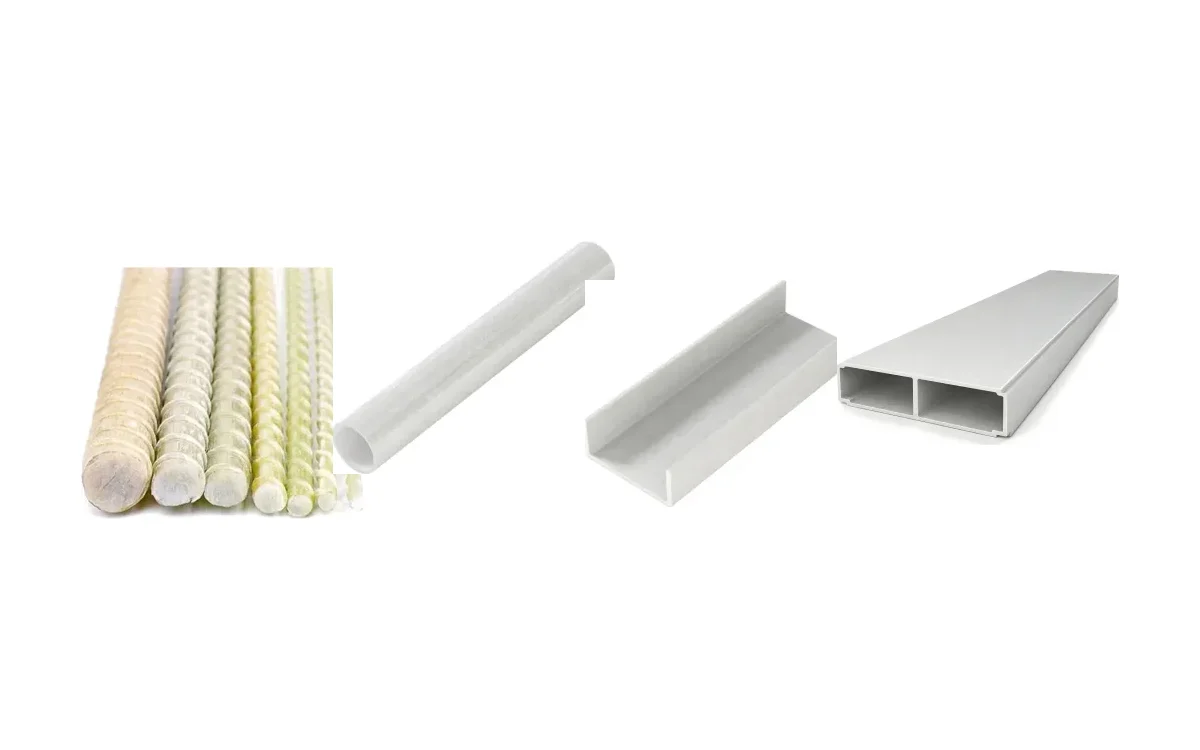
Both fiberglass (GFRP) and carbon fiber (CFRP) belong to the fiber-reinforced polymer (FRP) family, and both run through continuous pultrusion dies. Putting them side by side as "good versus better" misses how engineers actually choose between them. Carbon fiber is bought for stiffness per kilogram and zero thermal drift; fiberglass is bought for corrosion resistance, electrical insulation, toughness, and structural value per dollar.
Raw fiber properties: E-glass vs standard-modulus carbon
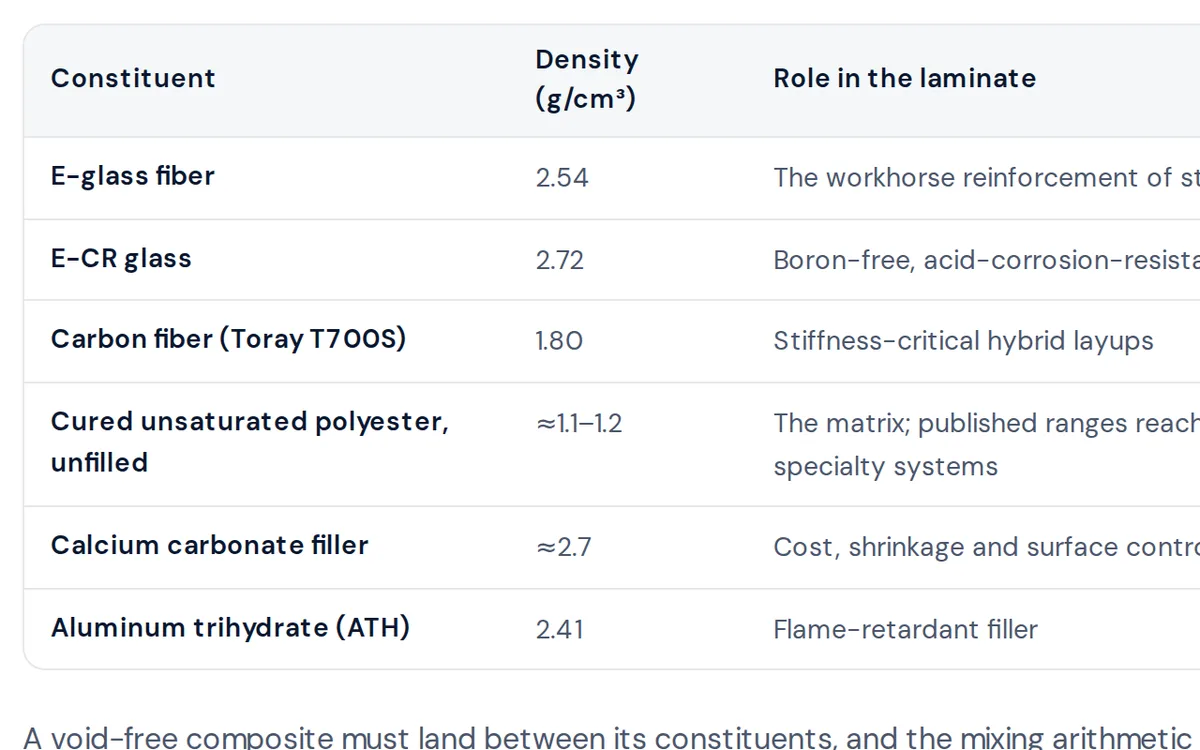
Comparing bare filaments first removes resin and layup differences. Carbon numbers below come from published Toray T300 and Toray T700S technical data sheets; E-glass ranges reflect standard industrial boron-free and conventional E-glass roving.
| Raw filament property | E-Glass fiber | Carbon fiber (Toray T300) | Carbon fiber (Toray T700S) |
|---|---|---|---|
| Density | 2.54–2.60 g/cm³ | 1.76 g/cm³ | 1.80 g/cm³ |
| Tensile modulus | 72–85 GPa | 230 GPa | 230 GPa |
| Tensile strength | 2,000–3,450 MPa | 3,530 MPa | 4,900 MPa |
| Elongation at break | ~3.0–4.8% | 1.5% | 2.1% |
| Axial CTE | ~5.0 × 10⁻⁶ /°C | −0.41 × 10⁻⁶ /°C | −0.38 × 10⁻⁶ /°C |
| Electrical behavior | Dielectric insulator | Electrically conductive | Electrically conductive |
| Galvanic corrosion with aluminum | None (inert) | Severe without isolation | Severe without isolation |
| Typical industrial fiber price (2024–2025) | ~USD 1.50–3.50 / kg | ~USD 22–35 / kg (standard industrial tow range) | ~USD 22–35 / kg (volume-dependent) |
Two traits immediately stand out besides stiffness. First, E-glass stretches roughly twice as far before breaking as T300 carbon, giving glass laminates noticeably better resistance to accidental impact and local crushing. Second, carbon fiber shrinks slightly along its length when warmed (negative CTE), which cancels the positive expansion of the resin matrix and makes carbon tubes hold optical or metrology alignment across temperature swings.
Pultruded laminate comparison: specific stiffness and specific strength
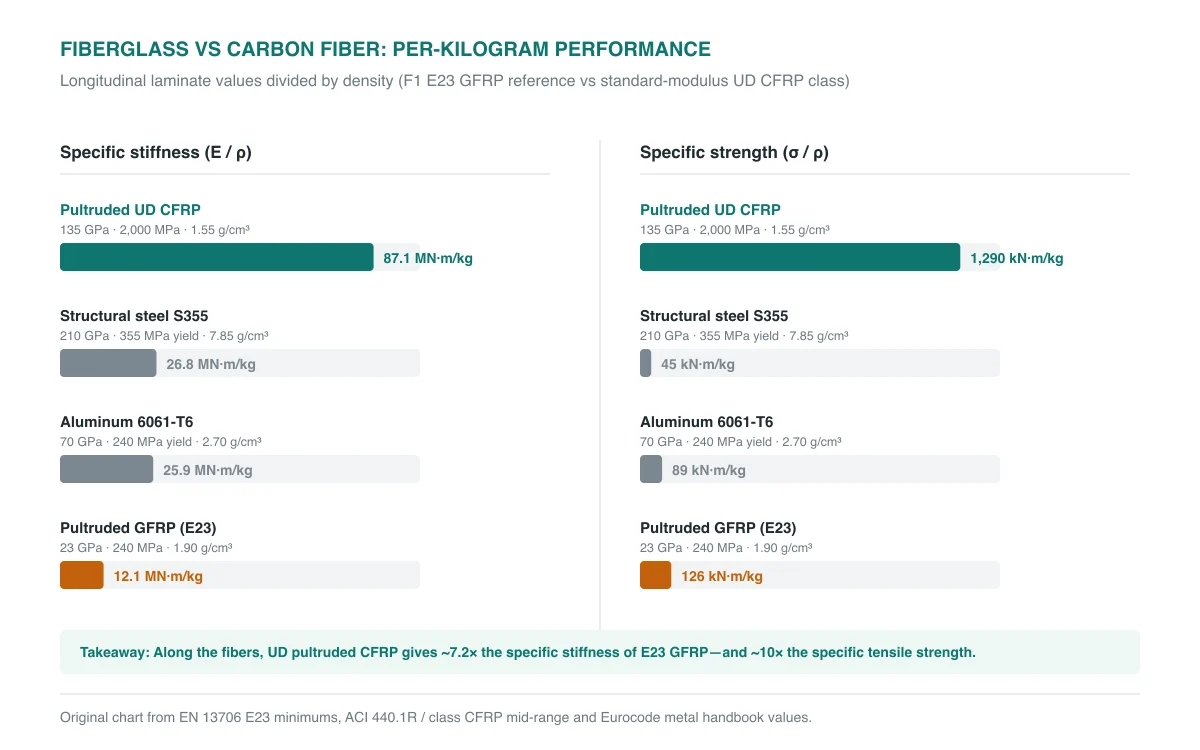
Structural buyers do not bolt bare fibers into a frame; they buy cured laminates. The table below compares F1 Composite's published EN 13706 E23 fiberglass structural reference (which includes continuous strand mat for transverse strength, giving 23 GPa longitudinal minimum modulus at 1.90 g/cm³) against published class values for unidirectional pultruded standard-modulus carbon (120 to 150 GPa class at ~1.55 g/cm³; midpoint 135 GPa and 2,000 MPa used for calculation) plus Eurocode metal benchmarks from our FRP vs traditional materials page.
| Material (longitudinal axis) | Density ρ (g/cm³) | Modulus E (GPa) | Comparison strength σ (MPa) | Specific stiffness E / ρ (MN·m/kg) | Specific strength σ / ρ (kN·m/kg) |
|---|---|---|---|---|---|
| Pultruded GFRP (F1 E23 minimum) | 1.90 | 23 | 240 (tensile min) | 12.1 | 126 |
| Pultruded UD CFRP (class midpoint) | 1.55 | 135 (class 120–150) | 2,000 (class range) | 87.1 | 1,290 |
| Aluminum 6061-T6 | 2.70 | 70 | 240 (yield) | 25.9 | 89 |
| Structural steel S355 | 7.85 | 210 | 355 (yield) | 26.8 | 45 |
The specific-stiffness column explains the entire business case for pultruded carbon. Per kilogram, an E23 fiberglass structural shape is actually less than half as stiff as steel or aluminum (12.1 vs 26.8 MN·m/kg), which is why deflection controls most glass FRP beam designs. Unidirectional pultruded carbon flips that equation completely: 87.1 MN·m/kg is roughly 3.3× the specific stiffness of steel or aluminum and 7.2× that of E23 fiberglass.
Note the layup caveat: E23 structural glass profiles deliberately devote part of their glass weight to mat layers so they can be bolted with standard steel hardware. Unidirectional carbon pultrusions put nearly all fibers at 0°, so they excel in axial tension, compression, and pure bending, while remaining resin-dominated and vulnerable to splitting across the fibers or under hard clamps.
Worked beam example: matching deflection on a 2.0 m span
Because stiffness scales as E × I and second moment of area I grows with the fourth power of section depth, moving to carbon shrinks both the outer envelope and the mass, though not by the full 7.2× specific-stiffness ratio when section depth is allowed to vary freely.
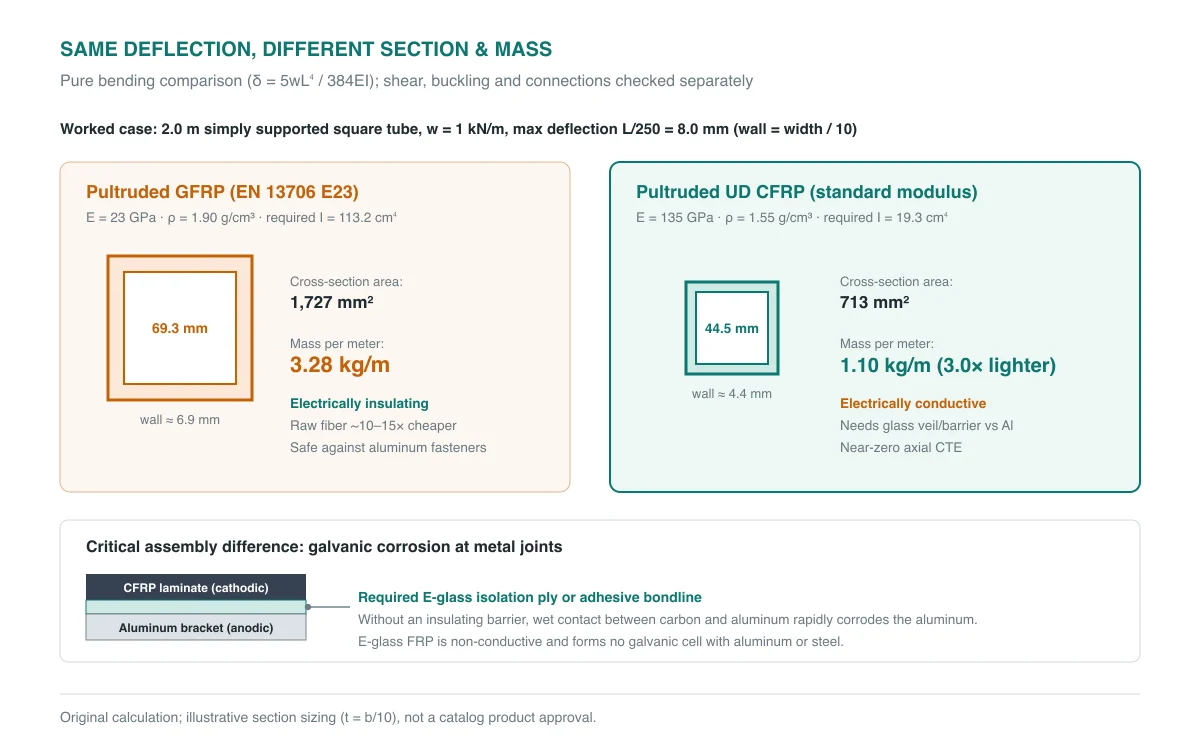
Consider a simply supported square hollow tube spanning L = 2,000 mm under a uniform line load w = 1.0 N/mm (1 kN/m), sized solely to keep midspan bending deflection within L/250 = 8.0 mm using δ = 5wL⁴ / (384EI). Keep geometric similarity by fixing wall thickness at one-tenth of outer width (t = b / 10, so I = 0.0492 b⁴ and area A = 0.36 b²).
- Required flexural rigidity: EI = 5 × 1 × 2,000⁴ / (384 × 8) = 26,042 N·m².
| Parameter | Pultruded GFRP (E23: 23 GPa, 1.90 g/cm³) | Pultruded UD CFRP (135 GPa, 1.55 g/cm³) | Ratio (GFRP / CFRP) |
|---|---|---|---|
| Required moment of inertia I | 113.2 cm⁴ | 19.3 cm⁴ | 5.87× |
| Required square tube width b (with t = b/10) | 69.3 mm (wall 6.9 mm) | 44.5 mm (wall 4.4 mm) | 1.56× |
| Cross-section area A | 1,727 mm² | 713 mm² | 2.42× |
| Beam mass per meter | 3.28 kg/m | 1.10 kg/m | 2.97× heavier |
Even letting the fiberglass tube grow 56% deeper to recover inertia, the equal-deflection carbon tube is still 3.0× lighter (1.10 vs 3.28 kg/m) and takes far less headroom. If depth were locked to the same 50 mm envelope for both materials (as in a tight robot gantry or window mullion), carbon would win by the full 7.2× mass ratio.
This screening calculation isolates pure Euler-Bernoulli bending; real members require separate checks for shear deflection, local wall buckling, end-bearing at supports, and adhesive or mechanical joints.
Electrical safety, galvanic corrosion, and radar transparency
Four non-mechanical properties often override weight completely:
- Electrical insulation. Glass-fiber profiles are routinely engineered for substation barriers, cable trays, third-rail coverboards, and utility hot sticks (subject to finished-assembly electrical testing). Carbon fiber conducts electricity; a carbon pole near energized lines is an electrocution hazard.
- Galvanic corrosion. Carbon is electrochemically noble. Bolting bare carbon tubes directly to aluminum brackets outdoors or near saltwater drives rapid galvanic pitting of the aluminum. Assemblies must insert a thin E-glass isolation ply, structural adhesive bondline, or polymer isolator washer between the two materials.
- RF and radar transparency. Fiberglass passes radio, cellular, and radar signals cleanly, which is why telecom radomes and antenna masts use GFRP. Carbon fiber reflects and attenuates RF signals and acts as an EMI shield.
- Failure warning. Unidirectional carbon fails abruptly in brittle fracture with little visual warning. Fiberglass stretches further before ultimate failure and shows resin crazing (whitening) as stress climbs.
When fiberglass wins vs when carbon fiber wins
| Application driver | Better fit | Why |
|---|---|---|
| Chemical-plant platforms, grating, handrails, cooling towers | Fiberglass (GFRP) | Corrosion resistance and cost govern; modest weight gain of deeper glass sections is acceptable |
| Utility ladders, live-line poles, substation fencing, radomes | Fiberglass (GFRP) | Electrical insulation and RF transparency eliminate carbon immediately |
| High-speed robotic arms, delta-robot linkages, long cantilevered booms | Carbon fiber (CFRP) | Moving inertia and settling time depend directly on E / ρ; lower mass allows smaller motors |
| Concrete beam strengthening strips and 70 m+ wind-blade spar caps | Carbon fiber (CFRP) | Thin bonded strips need 150+ GPa axial stiffness without adding bulk or dead weight |
| Optical benches, metrology frames, long survey rails | Carbon fiber (CFRP) | Near-zero axial thermal expansion holds alignment across shop temperature shifts |
| Tall curtain-wall mullions or oversized fiberglass window sashes | Glass-carbon hybrid | Carbon strip in outer flange controls wind deflection while glass core keeps cost and thermal conductivity low |
Sourcing glass or carbon pultrusions from F1 Composite
F1 Composite pultrudes both families: standard glass-fiber sections are listed under fiberglass structural shapes, while unidirectional carbon options are detailed on pultrusion carbon fiber, pultruded carbon fiber tubes, and pultruded carbon fiber plates. Remember that published carbon class ranges are screening values, not a batch datasheet; always confirm fiber grade, fiber volume, resin, and test direction on the project quotation.
Fiberglass vs carbon fiber questions
Is carbon fiber always stronger than fiberglass?
Along the fiber direction, standard-modulus carbon laminates have much higher tensile strength and roughly 5 to 6 times the elastic modulus of structural E23 fiberglass. Under blunt transverse impact, however, glass fibers absorb more strain energy before fracturing (higher elongation to break, ~2.5 to 4.8% bare filament vs ~1.5 to 2.1% for T300/T700S carbon), so fiberglass often survives knocks better.
Why does carbon fiber corrode aluminum when fiberglass does not?
Carbon is electrically conductive and sits near the noble (cathodic) end of the galvanic series. When bare CFRP touches aluminum or carbon steel in the presence of saltwater or condensation, it forms a galvanic cell that rapidly pits the metal. Designers place an insulating E-glass barrier ply, adhesive layer, or polymer bushing between carbon and metal hardware. Fiberglass is non-conductive and creates no galvanic reaction.
How much more expensive is carbon fiber than fiberglass?
On a raw-fiber basis in 2024–2025 industrial markets, standard E-glass roving typically trades around USD 1.50 to 3.50/kg, while industrial PAN-based carbon tow typically ranges from USD 22 to 35/kg (roughly a 10:1 to 15:1 fiber price ratio). Because carbon cuts member mass sharply in stiffness-driven designs, the finished-part cost multiple is often smaller than the raw-fiber multiple, but carbon still stays a major premium.
Can fiberglass and carbon fiber be combined in the same pultruded profile?
Yes. Hybrid pultrusion places carbon tows in the outer flanges where bending stress peaks, and E-glass roving plus mat in the web and outer skins for shear, cost control, and surface electrical isolation. Curtain-wall mullions and long window frames use hybrid glass-carbon layups to hit tight deflection targets without paying for all-carbon sections.
Does carbon fiber expand with heat like fiberglass?
No. Bare PAN carbon fiber has a slightly negative axial coefficient of thermal expansion (around −0.38 × 10⁻⁶/°C for Toray T700S), so a unidirectional carbon-epoxy profile sits near zero axial expansion. Pultruded E-glass profiles expand at roughly 8 to 11 × 10⁻⁶/°C lengthwise, close to concrete and structural steel.