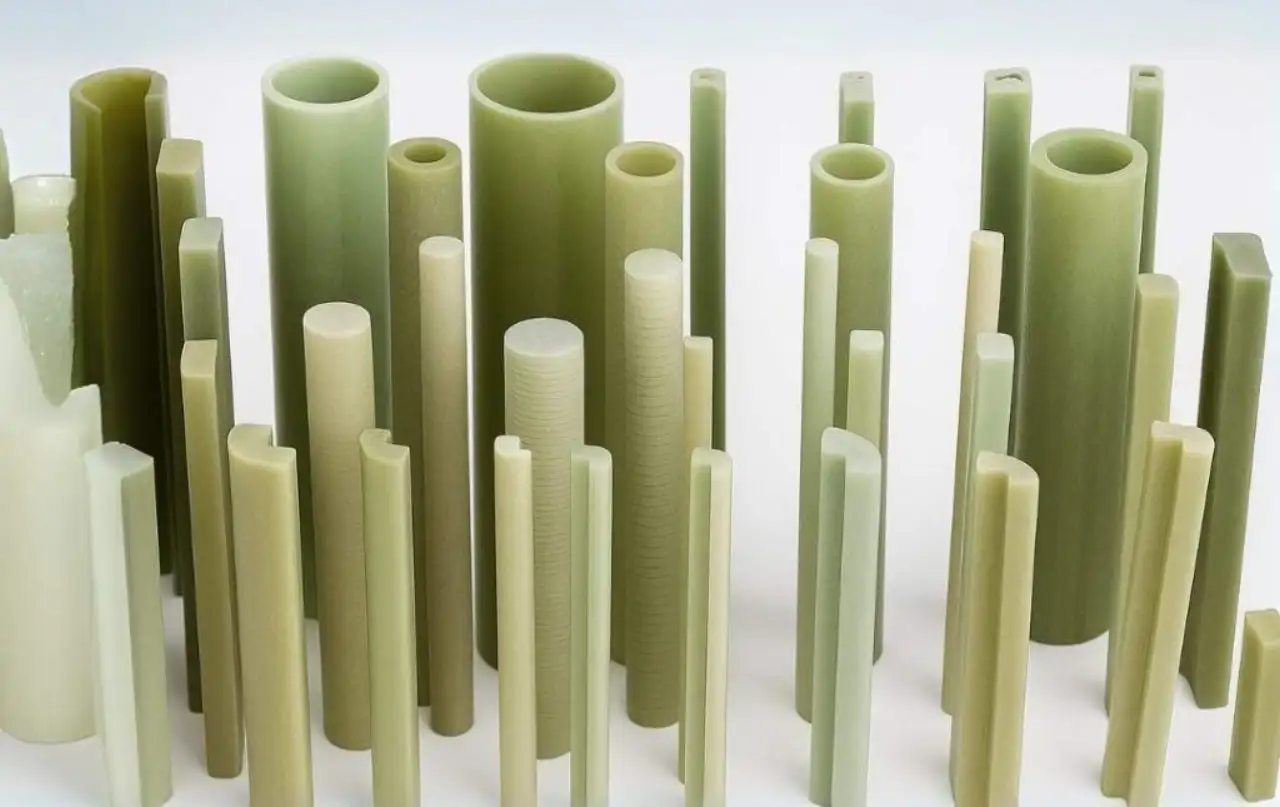
The FRP full form in construction is fiber reinforced polymer or fiber reinforced plastic. Both expansions describe a composite in which reinforcing fibers carry load inside a polymer resin matrix. “Polymer” is the technically broader matrix term; “plastic” remains common in product names, standards, procurement language, and search. In structural profiles, FRP most often refers to glass-fiber reinforced polymer, but the acronym can also include carbon, aramid, or basalt composites.
The important point is what FRP does not mean. It does not by itself identify the fiber, resin, glass content, manufacturing process, mechanical grade, fire class, or dimensional tolerance. “FRP beam” names a family in the same way that “metal beam” does. A useful drawing or purchase specification must add the missing identity.
What is the full form of FRP?
The two accepted expansions are fiber reinforced polymer and fiber reinforced plastic. British English spells the first word “fibre”; the material does not change. ICRI defines fiber-reinforced polymer as a general composite term covering a polymer matrix reinforced with fibers in forms such as fabric, mat, or strands.
| Acronym | Full form | What the term identifies |
|---|---|---|
| FRP | Fiber reinforced polymer or fiber reinforced plastic | The broad fiber-and-polymer composite family |
| GFRP | Glass fiber reinforced polymer or plastic | FRP made with glass reinforcement |
| GRP | Glass reinforced plastic | A common regional name for glass-fiber FRP |
| CFRP | Carbon fiber reinforced polymer | FRP made with carbon reinforcement |
| AFRP | Aramid fiber reinforced polymer | FRP made with aramid reinforcement |
| BFRP | Basalt fiber reinforced polymer | FRP made with basalt reinforcement |
Context matters with a short acronym. In Android device administration, FRP also means Factory Reset Protection. In Indian sugar policy, FRP means Fair and Remunerative Price. This engineering guide uses FRP only for the composite material; drawings or searches about beams, profiles, grating, rebar, tanks, or pipes normally point to the fiber-reinforced polymer meaning.
Why FRP has two accepted full forms
Fiber reinforced polymer emphasizes that the matrix is a polymer: a long-chain material that can be thermoset or thermoplastic. Structural pultrusions most often use thermoset polyester, vinyl ester, polyurethane, phenolic, or epoxy resin. Once cured, that matrix holds the fibers in position and transfers load between them.
Fiber reinforced plastic is the older and still widely used expansion. In this phrase, “plastic” describes the polymer matrix rather than an unreinforced commodity plastic. FRP does not behave like PVC sheet or injection-molded consumer plastic because continuous fibers can carry most of the structural load.
Writers also use hyphens—fiber-reinforced polymer and fiber-reinforced plastic. The meaning is unchanged. A document may use FRP as a noun (“the platform is FRP”) or an adjective (“FRP grating”). Neither form defines the grade.
FRP vs fiberglass, GFRP, and GRP
GFRP means glass fiber reinforced polymer or glass fiber reinforced plastic. The initial G removes ambiguity by identifying glass reinforcement. GRP, common in the UK, Europe, the Middle East, and Australia, means glass reinforced plastic. GFRP and GRP normally point to the same glass-and-resin material family.
Fiberglass is the common North American label. Strictly, glass fibers are the reinforcement and fiberglass reinforced plastic is the finished composite. In everyday product language, however, fiberglass grating, GFRP grating, GRP grating, and glass-reinforced plastic grating may describe the same product. Our fiberglass reinforced plastic guide explains the material architecture behind those labels.
FRP remains useful as the umbrella term. It allows one discussion to include several reinforcement systems, but that breadth is why it needs qualifiers in engineering work.
FRP full form in construction and civil engineering
In construction and civil engineering, FRP normally means fiber reinforced polymer or fiber reinforced plastic. The words that follow the acronym reveal the product form and design problem:
| Wording in a drawing or search | What it usually means |
|---|---|
| FRP profile, beam, channel, or angle | A structural shape, often pultruded GFRP |
| FRP grating, ladder, handrail, or cable tray | A corrosion-resistant access or cable-management product |
| FRP rebar | A fiber-reinforced polymer bar used in concrete |
| FRP pipe, tank, or vessel | A resin-and-fiber containment product made by a suitable process |
| FRP strengthening | Fiber composite bonded or anchored to an existing structural member |
The same acronym can therefore appear in a bridge specification, chemical-plant datasheet, or product search without identifying the same geometry or manufacturing route. The full form establishes the material family; the rest of the specification establishes the usable product.
Product form also signals how the fibers may be arranged and which properties govern. A pultruded member uses continuous fibers drawn through a heated die and is strongest along its length. Molded grating distributes reinforcement across a panel. FRP rebar is designed for axial reinforcement in concrete. A laminated shell may carry membrane loads in several directions. Calling all of these “FRP” is correct at the family level but insufficient for calculation or substitution.
Regional vocabulary adds another layer. North American documents often say FRP or fiberglass. British and Middle Eastern specifications frequently say GRP. European technical writing often uses GFRP. Search and tender documents may mix all three on the same project. The commercial label can change while the material requirement stays identical.
CFRP, AFRP, and BFRP meaning
The first letter usually identifies the reinforcement. CFRP is carbon fiber reinforced polymer, selected when high stiffness-to-weight or low thermal expansion can justify its cost. AFRP is aramid fiber reinforced polymer, associated with low density, impact behavior, and high tensile performance. BFRP is basalt fiber reinforced polymer. Hybrid FRP combines two or more fiber types, such as carbon and glass, to place expensive stiffness only where it adds value.
These materials are not interchangeable. A carbon laminate is electrically conductive; a glass laminate is typically insulating. Their modulus, density, compression behavior, surface treatment, joining approach, and economics differ. The acronym must therefore stay attached to a verified material record.
How to read FRP on a datasheet or drawing
After “FRP,” look for five qualifiers:
1. Reinforcement: E-glass, ECR glass, carbon, aramid, basalt, or a hybrid. 2. Matrix: polyester, vinyl ester, polyurethane, phenolic, epoxy, or a named thermoplastic. 3. Process and form: pultruded profile, molded grating, filament-wound pipe, laminate, rebar, or another product. 4. Grade and evidence: applicable standard, mechanical minimums, test direction, fire result, chemical-resistance basis, and batch traceability. 5. Geometry and tolerance: drawing revision, dimensions, section properties, surface finish, hole limits, and dimensional class.
For example, “pultruded E-glass/vinyl ester channel, EN 13706 E23, dimensions and tolerances per approved drawing and ASTM D3917” is actionable. “FRP channel, corrosion resistant” is not. ASCE/SEI 74-23 supplies an LRFD framework for applicable pultruded glass-FRP structural shapes, connections, and prefabricated products; it does not turn every FRP product into the same structural grade. The FRP material selection guide turns those qualifiers into a seven-step engineering workflow.
Frequently asked questions about the FRP full form
What is the FRP full form in civil engineering?
It is fiber reinforced polymer or fiber reinforced plastic. Civil-engineering documents then identify the reinforcement, resin, product form, test basis, and design standard needed for the application.
What is the FRP material full form?
The answer is the same: fiber reinforced polymer or fiber reinforced plastic. “FRP material” is not one universal grade, so published properties must be tied to a specific laminate, direction, process, and test method.
Is FRP the same as fiberglass?
Not always. Fiberglass can mean the raw glass reinforcement or a finished glass-FRP composite. FRP is broader because its reinforcement may be glass, carbon, aramid, basalt, or a hybrid.
What is the difference between fiber and fibre reinforced polymer?
Only regional spelling. “Fiber” is standard American English; “fibre” is standard British English. Both expand to FRP and describe the same composite family.
Which page should an engineer use next?
For the broad material explanation, start with What is FRP?. For material selection, use the FRP material guide. For dimensions, section data, and commercial product families, continue to the pultruded FRP profiles hub. That transition—from acronym to documented product—is where the full form becomes useful to an engineer or buyer.