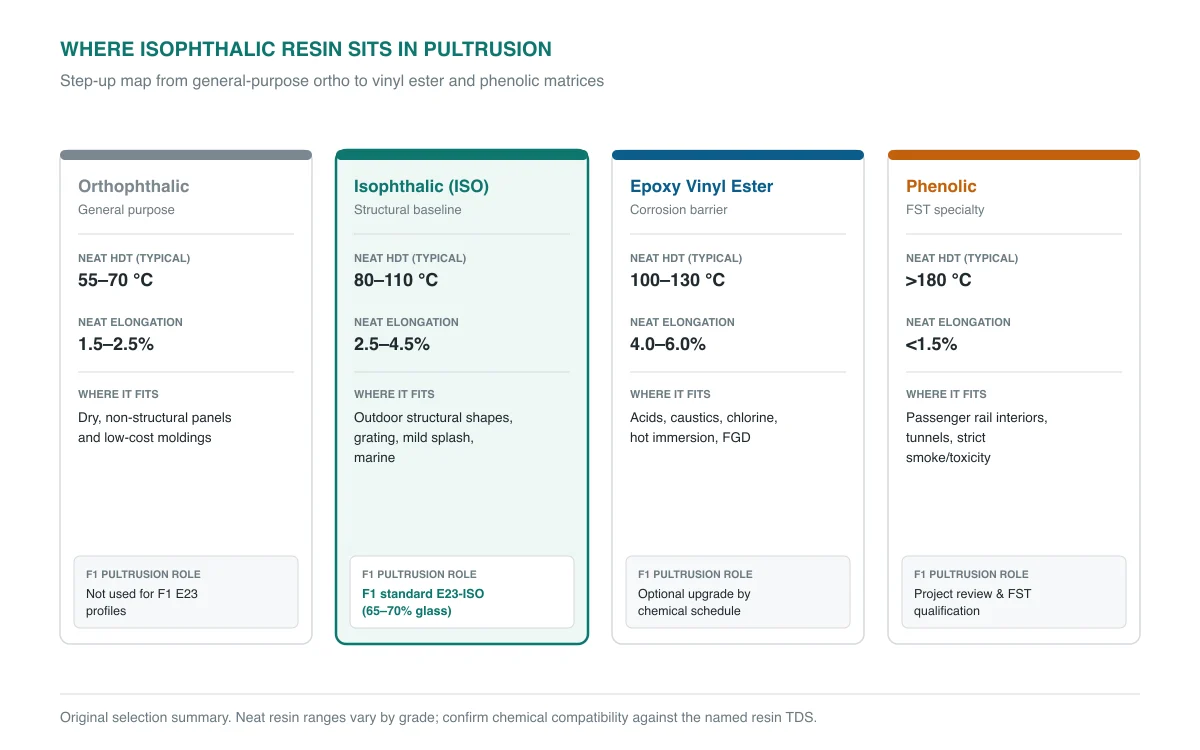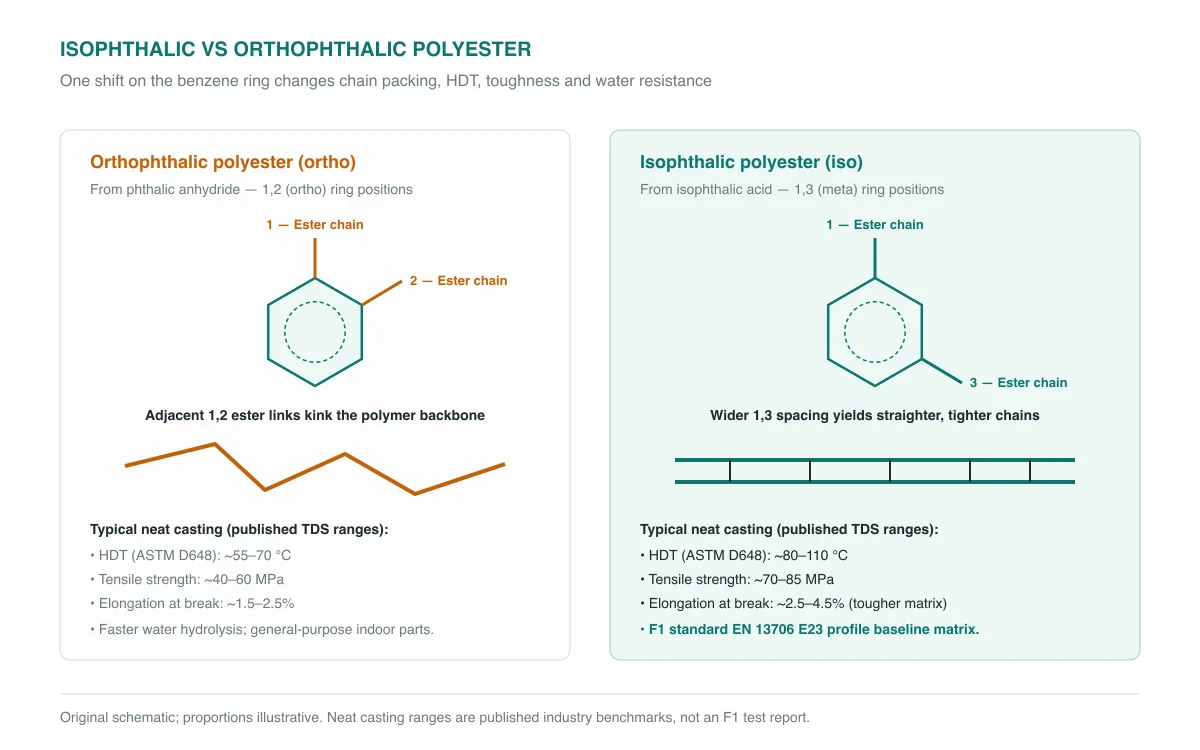
When a structural fiberglass quote says "polyester resin," the buyer still does not know what matrix is inside the profile. Two unsaturated polyesters can look identical on delivery yet perform very differently after three winters outdoors or a year over a damp wastewater channel. The dividing line is almost always orthophthalic versus isophthalic chemistry.
Why one ring position changes the polymer
Unsaturated polyester resins are built by condensing a glycol with two kinds of dibasic acids: an unsaturated acid (usually maleic anhydride, which supplies double bonds for later styrene cross-linking) and a saturated aromatic acid that spaces those cross-links and gives the chain rigidity.
- Orthophthalic polyester (ortho) uses phthalic anhydride. The two ester linkages sit next to each other on carbon positions 1 and 2 of the benzene ring. That crowding kinks the polymer backbone and limits how tightly chains pack, leaving ester groups more exposed to water and chemical hydrolysis.
- Isophthalic polyester (iso) uses purified isophthalic acid. The ester linkages sit on positions 1 and 3 (meta positions). Wider spacing allows longer, straighter molecular chains that pack more densely when cross-linked with styrene.
Longer chain length and tighter packing translate directly into higher neat tensile strength, higher elongation before matrix micro-cracking, higher heat deflection temperature (HDT), and slower moisture diffusion. Because purified isophthalic acid costs more than phthalic anhydride and requires higher reactor esterification temperatures, iso resins carry a modest raw-material premium over ortho grades.
Neat resin comparison: ortho vs iso vs epoxy vinyl ester
Published Technical Data Sheets (TDS) from major resin producers such as AOC (Palatal ortho vs Vipel/Synolite iso lines), Scott Bader (Crystic 197M ortho vs Crystic 272E and 625PA iso grades), and Polynt (general-purpose Distitron vs iso grades) show consistent property tiers for clear, unfilled neat resin castings tested under ASTM D638, ASTM D790, and ASTM D648. Individual formulations vary by styrene content and reactivity.
| Clear neat casting property | Orthophthalic polyester (general purpose) | Isophthalic polyester (structural / corrosion grade) | Epoxy vinyl ester (bisphenol-A type) |
|---|---|---|---|
| Heat Deflection Temp, HDT at 1.80 MPa (ASTM D648) | 55–70 °C | 80–110 °C | 100–130 °C |
| Tensile strength (ASTM D638) | 40–60 MPa | 70–85 MPa | 75–90 MPa |
| Tensile modulus (ASTM D638) | 2.5–3.5 GPa | 3.4–3.8 GPa | 3.2–3.6 GPa |
| Elongation at break (ASTM D638) | 1.5–2.5% | 2.5–4.5% | 4.0–6.0% |
| Flexural strength (ASTM D790) | 80–110 MPa | 110–140 MPa | 125–150 MPa |
| Hydrolysis and chemical resistance | Moderate; prone to blistering in wet service | High in water, salt spray, and mild acids | Very high in acids, caustics, and oxidizing media |
Higher elongation in the cured matrix matters more in pultrusion than many buyers expect. Under transverse tension or bolt bearing, the polymer matrix carries load between adjacent glass fibers. A resin that stretches 3.5% before cracking delays micro-cracking along the fiber-matrix interface, which in turn slows moisture wicking into the glass.
Iso-NPG upgrades for marine and UV exposure
For marine gelcoats, outdoor facade panels, and water-tank liners, formulators frequently swap standard propylene glycol for neopentyl glycol (NPG) to create an iso-NPG polyester. NPG's symmetrical branched methyl groups sterically shield the ester bond from water attack and improve gloss retention under ultraviolet exposure. In pultruded structural shapes, surface weatherability is handled jointly by an isophthalic or iso-NPG matrix, UV stabilizers, and a resin-rich polyester surfacing veil wrapped around the outside of the glass reinforcement.
How isophthalic resin shows up in F1 Composite's E23-ISO profiles
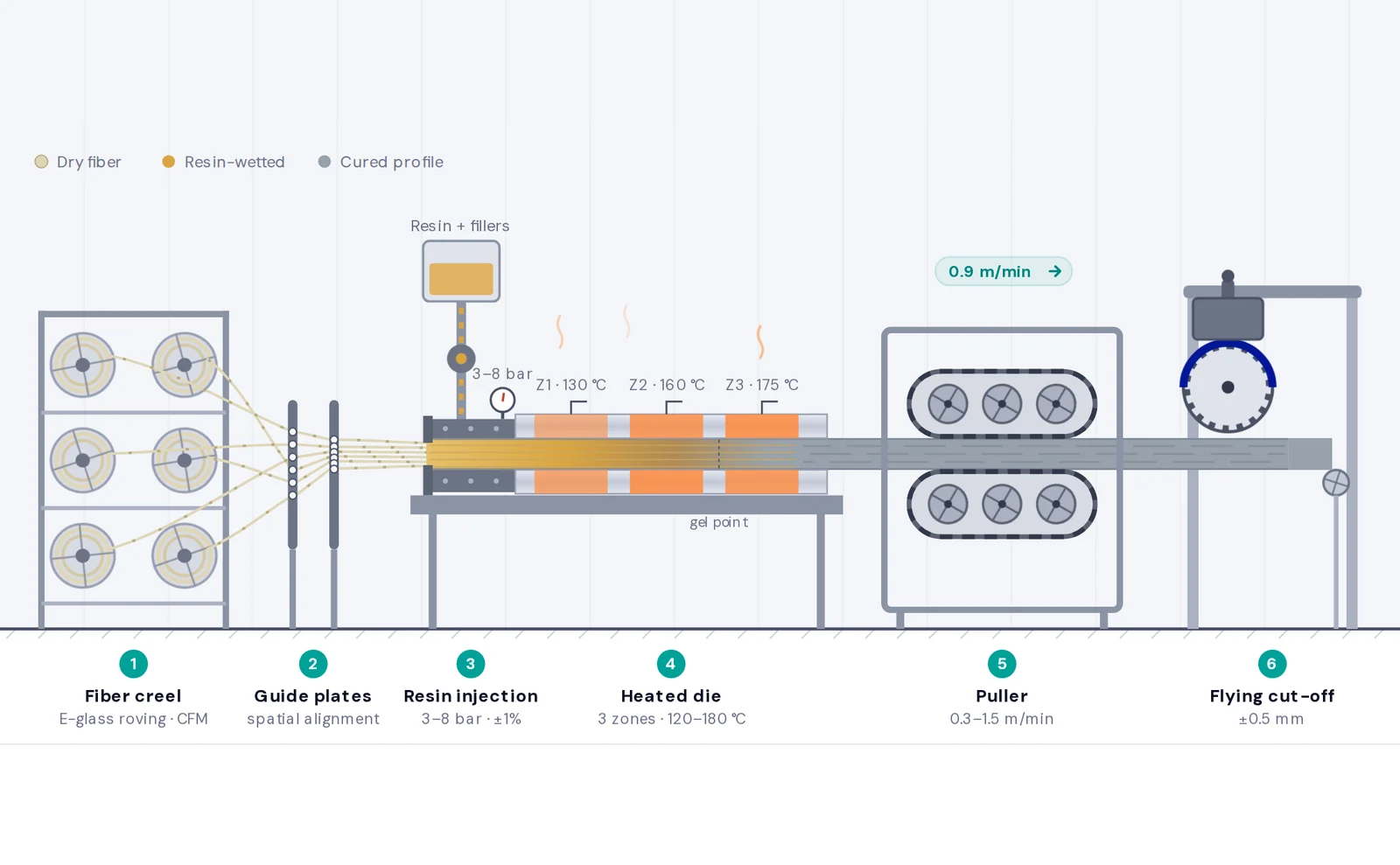
In a finished pultruded profile, continuous E-glass roving supplies most of the longitudinal stiffness and strength, while the isophthalic resin transfers shear between fibers, protects the glass from moisture, and sets the transverse and thermal floor.
The table below maps F1 Composite's published general-purpose E23-ISO laminate from our technical data page (EN 13706-3:2002 E23 minimums plus published industry-typical values for compressive strength, Barcol hardness, and 24-hour water absorption) to the physical role of the isophthalic matrix versus the glass reinforcement.
| F1 E23-ISO laminate property | Published value | Test method | What mainly governs it |
|---|---|---|---|
| Resin matrix & glass content | Isophthalic polyester; 65–70% glass by weight | Recipe basis | Balanced wet-out, stiffness, and weatherability |
| Nominal density | 1.9 g/cm³ | EN ISO 1183 / ASTM D792 | Weighted mix of E-glass (2.54) and cured iso resin (~1.2) |
| Longitudinal tensile modulus | 23 GPa (min) | EN ISO 527-4 | Continuous unidirectional glass roving |
| Transverse tensile modulus | 7 GPa (min) | EN ISO 527-4 | Continuous strand mat (CSM) + isophthalic matrix |
| Longitudinal tensile / flexural strength | 240 MPa (min) | EN ISO 527-4 / EN ISO 14125 | Unidirectional glass + fiber-matrix shear transfer |
| Transverse tensile strength | 50 MPa (min) | EN ISO 527-4 | Mat layers + cured iso resin toughness |
| Interlaminar shear strength (ILSS) | 30 MPa (published; EN min 25) | EN ISO 14130 | Directly tied to iso resin bond to glass and low void content |
| Pin-bearing strength (long. / trans.) | 150 / 70 MPa (min) | EN 13706-2 Annex E | Resin compressive support around bolted holes |
| Barcol hardness (typical) | 45 | ASTM D2583 | Degree of cure of the isophthalic matrix |
| 24-hour water absorption (typical) | 0.6% | EN ISO 62 | Hydrolysis barrier of the isophthalic matrix and surface veil |
Notice that Barcol hardness (45 typical), ILSS (30 MPa published), transverse properties, and 24-hour water absorption (0.6% typical) are the direct fingerprints of a properly cured isophthalic laminate. Under-cured resin or an unapproved downgrade to orthophthalic polyester shows up first as low Barcol readings, weaker bolt bearing, and elevated moisture pickup.
When isophthalic polyester is enough and when to step up
Do not over-specify vinyl ester on benign outdoor projects, and do not gamble on isophthalic polyester in hot caustics or chlorine. Use the service environment as the filter:
| Operating condition | Isophthalic polyester (ISO) | Step up to Epoxy Vinyl Ester | Step up to Phenolic / FR grade |
|---|---|---|---|
| General outdoor frames, walkways, handrails, solar racks | Standard choice (with UV veil) | Usually unnecessary cost | Only if project sets ASTM E84 Class A or rail FST rules |
| Coastal salt spray and marine piers (above splash zone) | Proven baseline for structural shapes | Preferred for permanent seawater immersion or heavy wave impact | Only if strict tunnel/marine FST applies |
| Municipal water & wastewater (dilute H₂S, mild chlorination) | Suitable for many overhead frames and supports; check concentration | Preferred for direct chlorine/hypochlorite splash, scrubbers, or chemical dosing rooms | Only if enclosed fire-smoke rules apply |
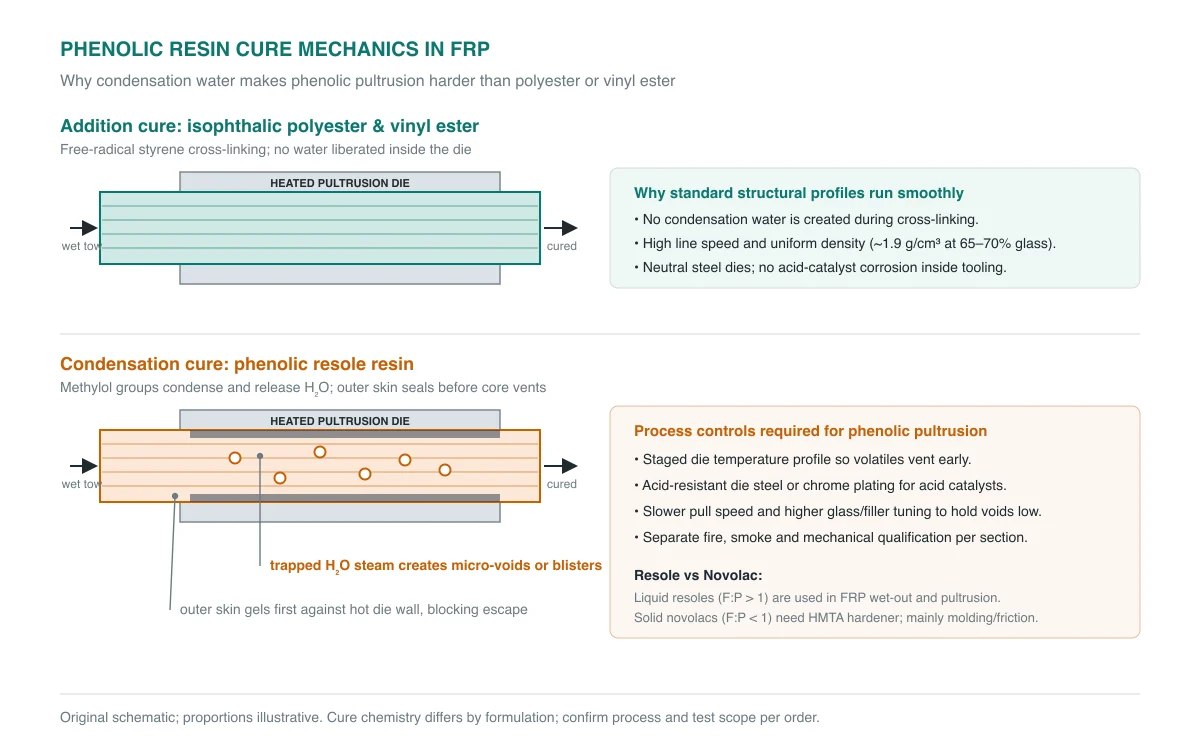
| Strong mineral acids, caustic soda (NaOH), solvents, > 60 °C wet exposure | Not recommended; ester groups hydrolyze | Required; verify exact chemical, concentration, and temperature on resin supplier's chart | Verify alkali sensitivity (phenolic fails in strong caustics) |
| Passenger rail interiors, underground transit with smoke/toxicity caps | Does not meet rail smoke/toxicity limits unmodified | Halogenated FR grades may fail smoke density | Evaluate phenolic resin or qualified low-smoke systems |
Ordering isophthalic pultruded profiles from F1 Composite
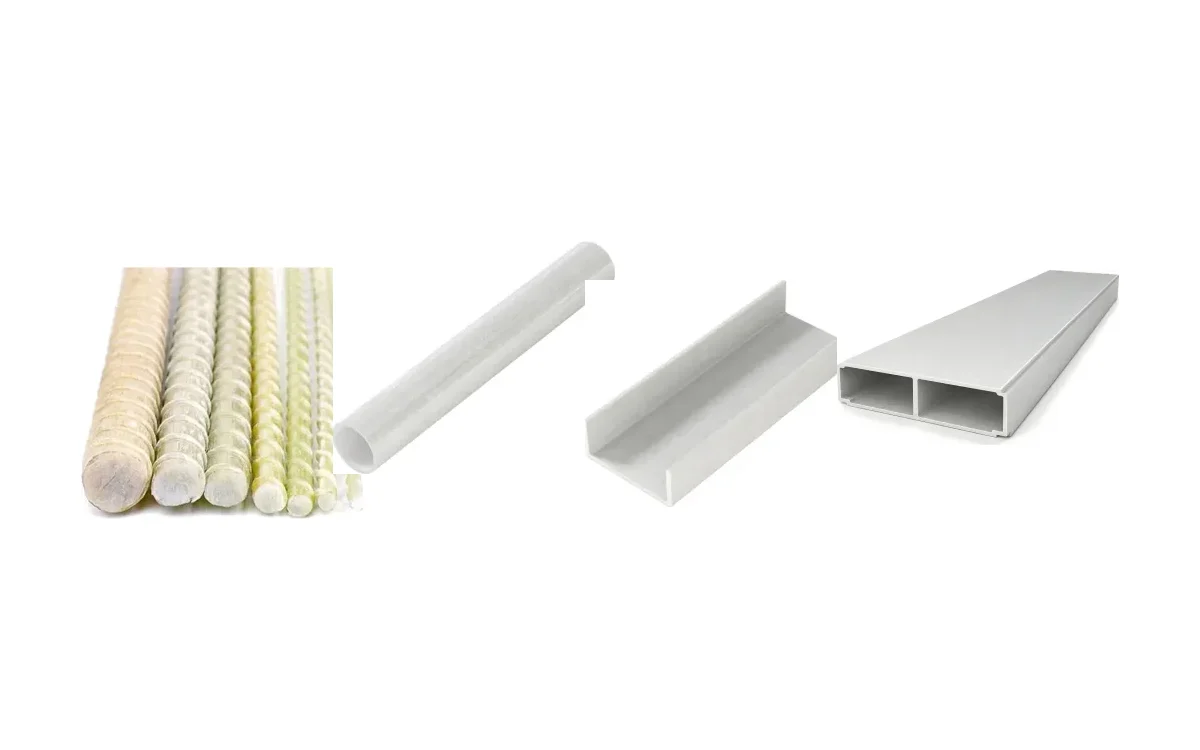
Every standard section on our fiberglass structural shapes catalog defaults to the E23-ISO isophthalic polyester system unless the quotation states a vinyl ester or fire-retardant formulation. Standard production lead time is 4–8 weeks with a minimum order of 1,000 m per section.
If your environment involves chemical splash, immersion, elevated service temperatures, or UV exposure, send the chemical list, concentrations, operating temperatures, and required test standards through our pultrusion resin systems review before locking in the resin grade.
Isophthalic resin questions
What does 'iso resin' mean on a fiberglass profile quotation?
Iso resin is shorthand for isophthalic unsaturated polyester resin. In structural pultrusion, it is the standard workhorse matrix chosen over lower-cost orthophthalic polyester because it holds up better outdoors, absorbs less moisture, and resists thermal distortion better.
Is isophthalic polyester waterproof?
No organic polymer is 100% impermeable to water vapor, so specifications measure 24-hour water absorption (EN ISO 62) and long-term property retention in wet service. Isophthalic polyester resists hydrolysis far better than orthophthalic resin, which is why marine hulls, water-treatment frames, and outdoor pultrusions specify iso or iso-NPG systems rather than ortho.
What is an iso-NPG resin or gelcoat?
Iso-NPG combines isophthalic acid with neopentyl glycol (NPG) as the diol component. NPG lacks vulnerable beta-hydrogen atoms and shields adjacent ester linkages from water and UV attack. Boat builders and tank fabricators use iso-NPG gelcoats and barrier coats to prevent osmotic blistering and color chalking.
When is isophthalic resin not enough, requiring vinyl ester instead?
Switch to an epoxy vinyl ester when the profile faces strong mineral acids, alkaline/caustic solutions (such as sodium hydroxide), sodium hypochlorite bleach, solvents, or continuous hot chemical immersion. Vinyl ester has fewer ester groups per chain, all located at chain ends where methyl groups shield them from chemical attack.
Can I verify whether a delivered profile used isophthalic resin instead of orthophthalic?
Yes. Request the batch resin certificate of analysis (CoA) and supplier TDS with the order, and for high-value contracts verify via Fourier-transform infrared spectroscopy (FTIR) or pyrolysis GC-MS on a retained coupon, which distinguishes meta-substituted isophthalic rings from ortho-substituted phthalic rings.