Buyers rarely ask for phenolic resin because it is easy to process or cheap to tool. They ask for it because a transit authority, tunnel operator, or offshore platform specification rejects the smoke density and toxicity numbers of standard polyester and vinyl ester laminates.
Leo Baekeland patented the first commercial phenol-formaldehyde resin (Bakelite) in 1909, making phenolics the oldest synthetic thermoset family still in heavy industrial use. In modern composite manufacturing, phenolic remains a specialist matrix chosen almost exclusively when fire, smoke, and toxicity (FST) rules govern the specification.
Resole vs novolac: two chemistries under one name
Phenol and formaldehyde react through step-growth polycondensation, and the molar ratio of the two ingredients decides whether the resulting resin is self-curing or needs an added cross-linker.
| Resin class | Molar ratio (F:P) | Catalyst in synthesis | Physical form | How it cures | Typical composite role |
|---|---|---|---|---|---|
| Resole | > 1.0 (excess formaldehyde) | Alkaline (base) | Liquid solution or syrup | Heat and/or acid catalyst; self-condenses via methylol groups | Wet lay-up, RTM, prepregs, and phenolic pultrusion |
| Novolac | < 1.0 (excess phenol) | Acid | Solid flakes, powder, or solvent blend | Requires hardener (commonly HMTA) plus heat | Compression molding compounds, friction pads, epoxy-novolac modifiers |
In fiber-reinforced plastics, "phenolic resin" almost always means a liquid resole. The active methylol groups along the resole chain bridge to adjacent aromatic rings during cure, locking the resin into a tightly cross-linked, benzene-ring-dense network. That high aromatic carbon content is the direct chemical reason phenolic chars instead of melting or feeding flames.
Why condensation cure makes phenolic pultrusion difficult
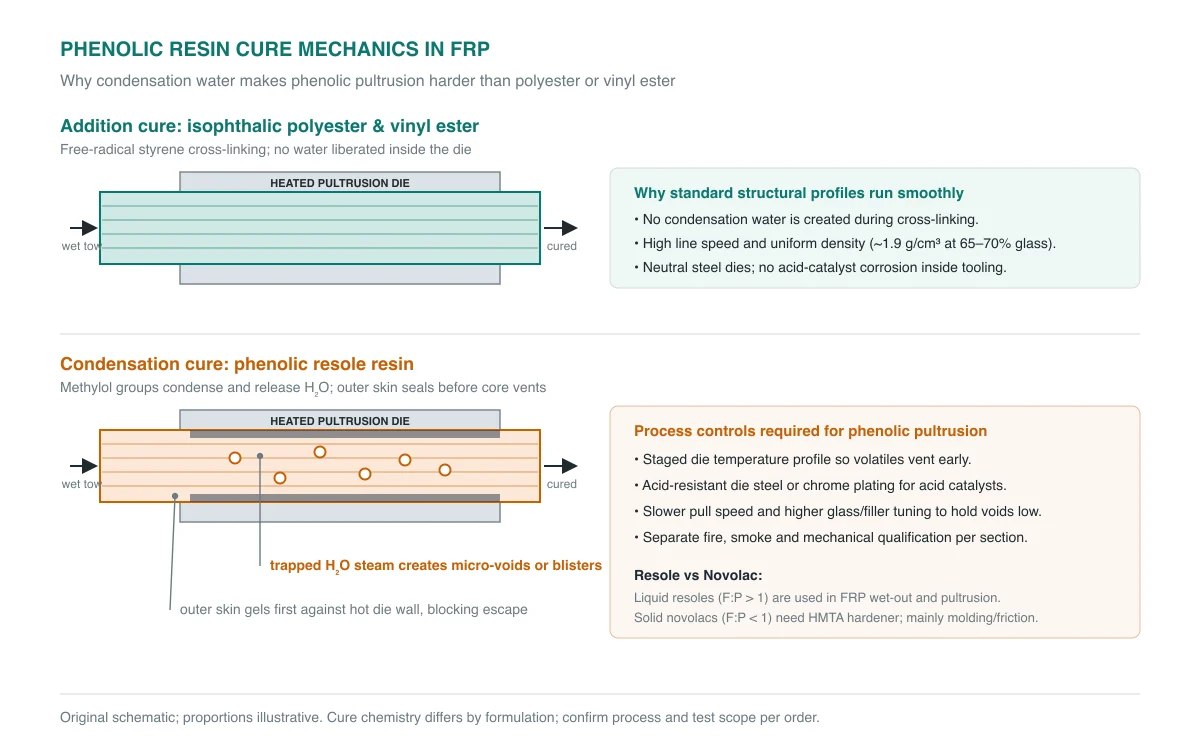
Unsaturated polyester and epoxy vinyl ester cure by free-radical addition across styrene double bonds. Nothing leaves the molecule as a gas during cross-linking, so a properly catalyzed profile leaves a heated pultrusion die dense and low in voids.
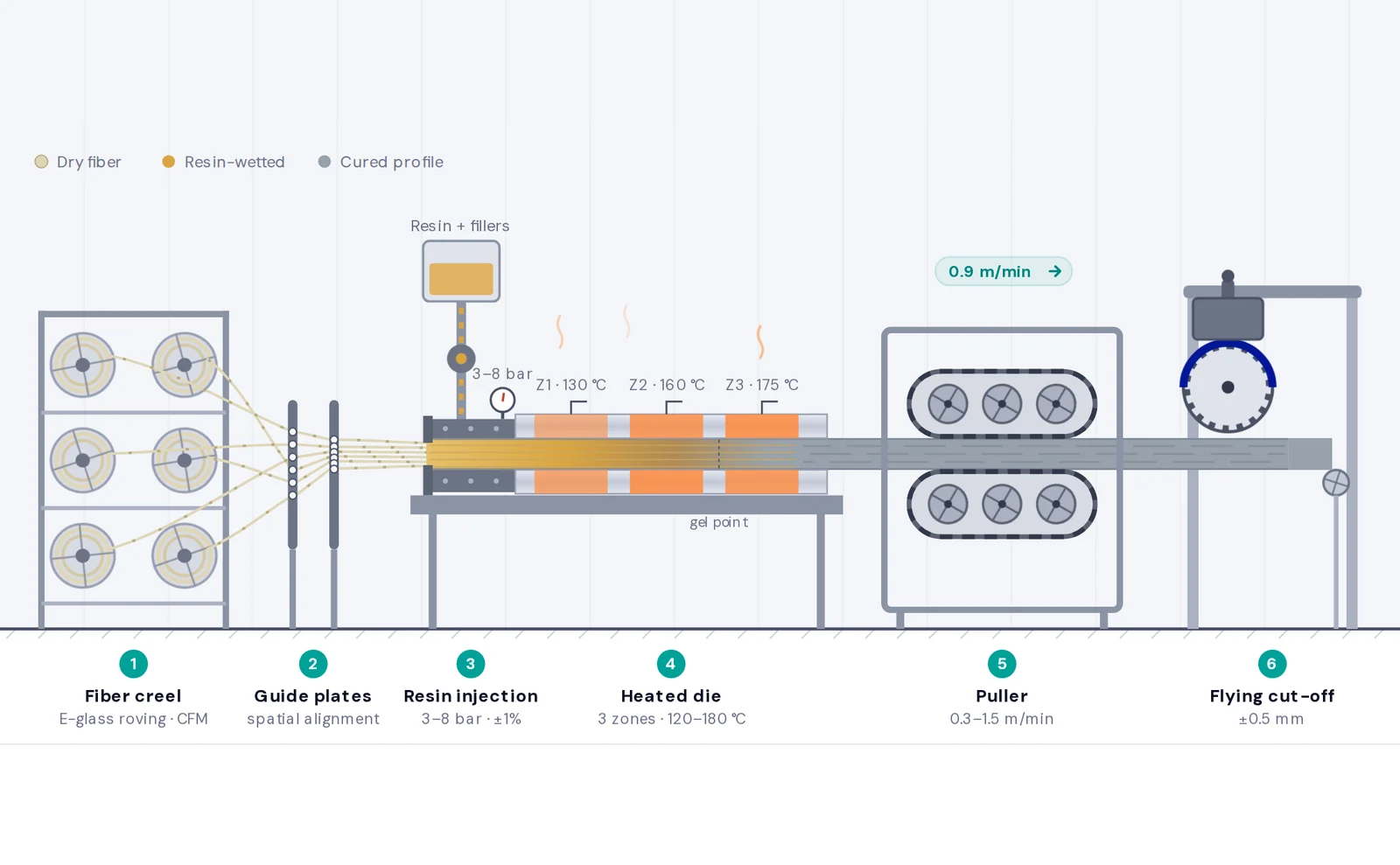
Phenolic resoles cure by condensation. Every cross-link splits off a water molecule, and commercial liquid resoles already carry free water to hold viscosity down for fiber wet-out. Inside a closed pultrusion die heated above 100 °C, that moisture wants to flash into steam.
Three shop-floor consequences follow directly from this chemistry:
- Trapped steam drives internal voids. The laminate closest to the steel die walls heats and gels first, sealing the outer skin while the core is still condensing. Steam trapped behind that skin creates micro-voids, lower interlaminar shear strength, and surface blisters if line speed or die temperature rises too quickly.
- Acid catalysts attack tooling. Room-temperature or rapid-cure resoles frequently rely on organic sulfonic or phosphoric acid catalysts. Standard unplated pultrusion dies corrode rapidly unless built from acid-resistant stainless steel or protected with heavy hard-chrome plating.
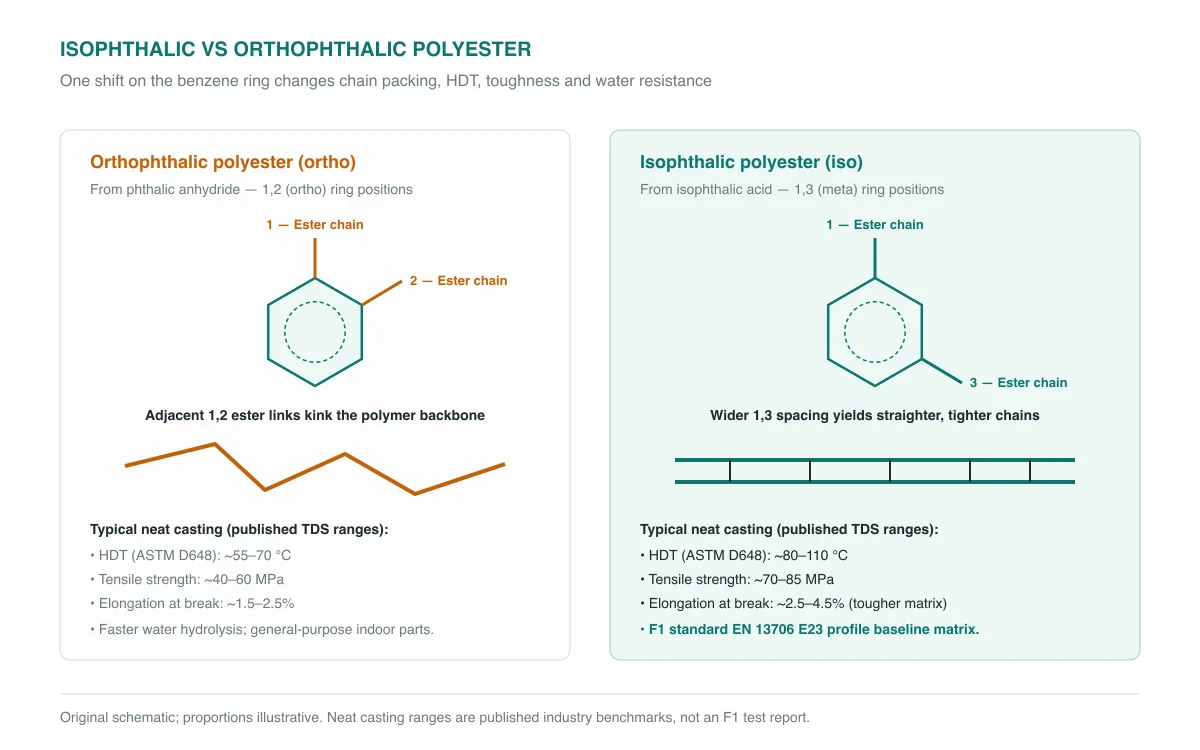
- Mechanical toughness is lower. Neat cured phenolics are relatively brittle, with tensile elongation typically under 1.5% compared with 2.5 to 4.5% for isophthalic polyester and 4.0 to 6.0% for epoxy vinyl ester. Fiber sizing must also be matched to phenolic chemistry, because standard polyester-compatible E-glass sizing wets poorly in aqueous resole baths.
Pultruders mitigate void growth with staged die temperature zones (a cooler entry zone to let volatiles migrate backward before gelation), injection boxes that maintain resin back-pressure, slower pull speeds, and tailored mineral fillers. All of those steps raise manufacturing cost relative to standard structural profiles.
Fire, smoke, and toxicity standards that drive phenolic specifications
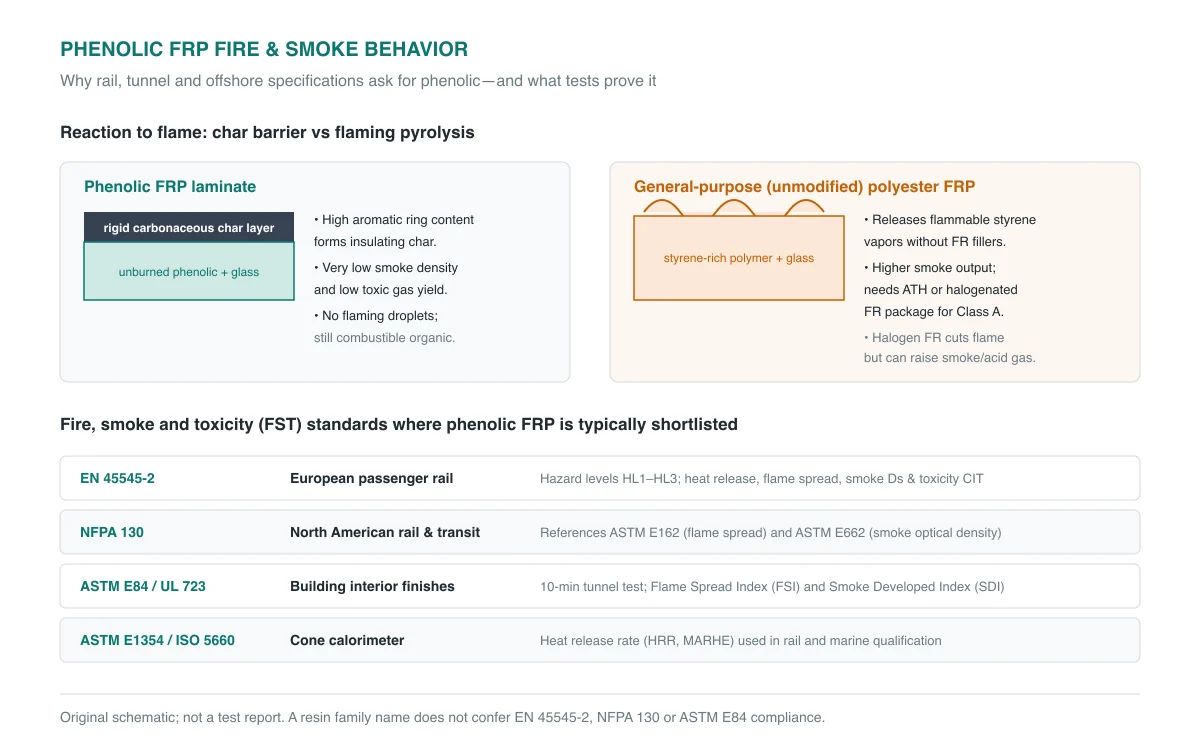
Glass fibers themselves do not burn, so fire behavior in FRP comes from the resin, fillers, surface veil, and laminate thickness. When an unmodified polyester burns, the polymer depolymerizes into volatile styrene monomer that sustains flaming combustion and dense soot. Phenolic behaves differently: heat dehydrates the aromatic network into a rigid, insulating carbonaceous char that slows heat release and starves the flame front.
Engineers encounter phenolic most often under four test regimes:
| Standard | Primary market | What it measures | Why phenolic is shortlisted |
|---|---|---|---|
| EN 45545-2 | European passenger rail vehicles | Flame spread, heat release (MARHE via ISO 5660-1), smoke optical density, and gas toxicity (CIT) for Hazard Levels HL1 to HL3 | Achieves low heat release, low smoke, and low toxicity together for enclosed train interiors and underframe ducts |
| NFPA 130 | North American passenger rail and fixed guideway transit | References ASTM E162 (surface flammability) and ASTM E662 (smoke optical density Ds at 1.5 and 4.0 min) | Meets tight flaming and non-flaming smoke limits that halogenated polyesters frequently miss |
| ASTM E84 | North American building and industrial finishes | 10-minute Steiner tunnel Flame Spread Index (FSI) and Smoke Developed Index (SDI) | Qualified phenolic laminates routinely post very low FSI and SDI, well below the Class A limits (FSI ≤ 25, SDI ≤ 450) |
| ASTM E1354 | Cone calorimeter research, marine, and rail qualification | Peak and average heat release rate (HRR), effective heat of combustion, and smoke yield under controlled irradiance | Quantifies heat-release behavior across thicknesses and resin-filler packages |
Passing one standard does not establish compliance with another, and a resin name alone certifies nothing. As noted in our FRP fire resistance ratings guide, qualification depends on the exact resin grade, glass architecture, wall thickness, adhesive or coating, and mounting condition documented in the laboratory report.
Phenolic vs FR polyester, vinyl ester, and isophthalic polyester
Published neat-resin and composite benchmark ranges illustrate the trade-offs a buyer actually makes when stepping up from standard structural resin to phenolic. Values below are published industry ranges, not F1 Composite test certificates.
| Property / criterion | Isophthalic polyester (F1 E23-ISO baseline) | ATH-filled or halogenated FR polyester | Epoxy vinyl ester (FR grade) | Phenolic resole FRP |
|---|---|---|---|---|
| Cure mechanism | Addition (styrene) | Addition (styrene) | Addition (styrene) | Condensation (liberates H₂O) |
| Typical neat HDT (ASTM D648) | 80–110 °C | 75–105 °C | 100–130 °C | > 180 °C (post-cured) |
| Neat tensile elongation | 2.5–4.5% | 1.5–3.0% | 4.0–6.0% | < 1.5% |
| Smoke density (ASTM E662) | High | Moderate (ATH) to high (halogen) | Moderate to high | Very low |
| Acid / alkali resistance | Mild chemical splash; atmospheric | Mild splash; verify filler vs acid | Broad acid, caustic, and chloride service | Good acid resistance; poor strong alkali resistance |
| Relative pultrusion cost & tooling | Baseline (1×) | Moderate premium; higher filler wear | Moderate-to-high premium | High premium; acid-resistant dies and slower line speed |
| Appearance and colorability | Full pigment range | Full pigment range | Full pigment range | Naturally dark brown/amber; limited light colors |
Notice two practical traps in that table. First, phenolic resists many acids and solvents well, yet strong alkalis attack cured phenolic resins rapidly. Second, raw phenolic cures to a reddish-brown or dark amber tone, so architectural light colors require a qualified gelcoat or topcoat that must itself pass the project's FST tests.
When to specify phenolic vs an alternative matrix
Use the decision table below to check whether a specification truly requires phenolic before paying its tooling and qualification penalty.
| Project requirement | Recommended resin family to evaluate | Reason |
|---|---|---|
| Enclosed passenger rail interior, subway station duct, or tunnel cable barrier with HL2/HL3 or NFPA 130 smoke and toxicity caps | Phenolic resole (or qualified ultra-low-smoke acrylic/ATH hybrid) | Smoke optical density and gas toxicity, not flame spread alone, eliminate conventional halogenated FR polyesters |
| Offshore platform grating or walkway requiring jet-fire or strict low-smoke integrity | Phenolic grating system | Low smoke and char retention preserve visibility along escape routes |
| Industrial walkway, chemical platform, or building exterior needing ASTM E84 Class A (FSI ≤ 25) without strict smoke-toxicity caps | ATH-filled FR isophthalic polyester or FR vinyl ester | Achieves Class A flame spread with faster pultrusion, better impact toughness, and full color options |
| General outdoor structural frame, handrail, or mild coastal exposure | Isophthalic polyester (see our isophthalic resin guide) | Balanced mechanical performance, weatherability, and standard production lead time |
| Strong caustic (NaOH) or bleach immersion with fire-retardant requirement | Fire-retardant epoxy vinyl ester | Phenolic degrades in strong alkalis; vinyl ester handles both caustic exposure and flame-retardant filler packages |
How F1 Composite handles phenolic and fire-rated inquiries
F1 Composite's published EN 13706 E23 structural catalog uses isophthalic polyester resin, and standard pultrusion options are reviewed on the pultrusion resin systems page.
Because phenolic pultrusion involves dedicated acid-resistant tooling, slower cure profiles, and expensive third-party FST specimen testing, F1 does not offer phenolic profiles as off-the-shelf stock. For rail or tunnel inquiries, review the component qualification checklist on fire-retardant rail profiles and submit the section drawing, exact fire standard edition, required hazard level or smoke threshold, wall thickness, and annual volume before budgeting tooling or lead time.
Phenolic resin FRP questions
What is the difference between resole and novolac phenolic resin?
Resoles are made with an excess of formaldehyde under alkaline catalysis, leaving reactive methylol groups that cross-link with heat or acid catalysts. Novolacs are made with an excess of phenol under acid catalysis; they are thermoplastic solids until heated with a curing agent such as hexamethylenetetramine (HMTA). FRP laminates and pultrusions use liquid resoles.
Why is phenolic resin harder to pultrude than polyester or vinyl ester?
Polyesters and vinyl esters cure by free-radical addition and release no water. Phenolic resoles cure by condensation and generate water inside the die. Once the outer skin gels against the hot die wall, trapped water flashes to steam and creates voids or blisters. Acid catalysts also attack standard tool steels, requiring corrosion-resistant die surfaces and slower pull speeds.
Is phenolic FRP non-combustible?
No. Glass fibers are non-combustible, but phenolic resin is still an organic polymer. It resists ignition and forms a rigid, low-smoke carbonaceous char instead of dripping or giving off dense black styrene smoke, which helps qualified laminates pass EN 45545-2 or NFPA 130 criteria. Non-combustibility tests such as ASTM E136 or EN ISO 1182 are a separate bar.
How does phenolic FRP compare with brominated fire-retardant polyester?
Brominated or chlorinated polyesters achieve low flame spread (ASTM E84 Class A) at lower cost and run cleanly on standard pultrusion lines, but halogen flame retardants can produce denser smoke and acidic combustion gases. Phenolic achieves low flame spread, low smoke optical density (ASTM E662), and low toxicity without halogens, at the expense of higher processing cost and lower impact toughness.
Does F1 Composite stock phenolic pultruded profiles?
No. F1 Composite's published structural catalog uses isophthalic unsaturated polyester (E23-ISO). Phenolic profiles require project-specific review of section geometry, tooling corrosion protection, laminate properties, and the exact fire-test qualification scope before series supply is quoted.